 info@dejunindustry.com
 +86 13733828692


Advantages of Stage Hoist
The core advantages of stage hoists are safety and reliability, precise control, high efficiency and convenience, and strong adaptability. They perfectly match the core needs of stage performances — "safety first, precise operation, rapid work, and limited space". As core lifting equipment for modern stage setup, performance scene changes, and equipment hoisting, they are more capable of meeting the professional and special requirements of stage scenarios compared with traditional manual hoists or general-purpose electric hoists. More details of introduction to the advantages of stage hoists are as below.
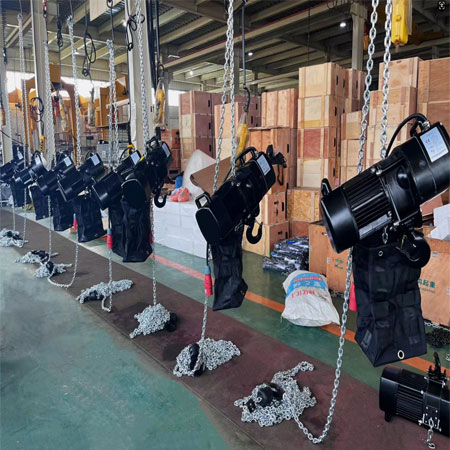
I. Outstanding Safety Performance, Adapting to High Safety Requirements of Stages
1. Multiple Safety Protection Mechanisms
Standard configurations include overload protection (preventing equipment damage or falling caused by overloading), phase failure protection (avoiding motor burnout due to three-phase power phase loss), limit protection (upper and lower travel limits to prevent hook overtravel/undershoot), and emergency stop button (rapid power-off in emergency situations). Some high-end models of stage hoists are also equipped with leakage protection and anti-drop hook devices (self-locking hook design to prevent loads from slipping), fully meeting the "zero-accident" safety requirements for stage performances.
2. Low-Noise Operation
The motor of electric stage hoist adopts a silent design, and the transmission system is optimized (e.g., gearbox noise reduction treatment). The operating noise is usually below 60db, which will not interfere with stage sound effects or line delivery. It is suitable for the "silent operation" needs during performances (such as scene changes during performance intervals or setup without affecting the audience experience).
3. Stable Braking System
Electromagnetic braking or mechanical braking is adopted to stage hoists, featuring fast braking response and strong braking force. There is no sliding when the load is suspended, and even in case of sudden power failure, it can lock instantly, ensuring the safe suspension of precision/valuable equipment such as lighting, audio, and stage scenery.
II. Precise Control, Meeting the Refined Operation Needs of Stages
1. Stepless Speed Regulation or Multi-Gear Speed Regulation:
Supports low-speed micro-movement (the minimum speed of some models of stage hoists can be as low as 1m/min or less), enabling precise control of the lifting and traversing speed of loads. It adapts to the "precision alignment" needs in stage scenarios — such as millimeter-level adjustment during lighting equipment installation, smooth scene changes, and smooth lifting of actors using wire ropes (avoiding jams or sudden speed changes).
2. Flexible and Convenient Operation
The stage hoist can be operated with wired handles or wireless remote controls (infrared/RF). The remote control has a typical control range of 10-50 meters, allowing operators to control remotely from the stage wing, audience area, or control console without close contact with the load. It is suitable for complex stage layouts (e.g., high-altitude operations, synchronous operation of multiple devices).
3. Bidirectional Operation plus Precise Positioning
The stage hoist supports lifting, left-right traversal (some models are equipped with traversing trolleys). The operation track is stable without shaking or deviation, enabling rapid and accurate delivery of equipment to designated positions. This improves the efficiency of stage setup and scene changes (such as quickly arranging lighting trusses and backdrops before performances, and rapid scene switching during performances).
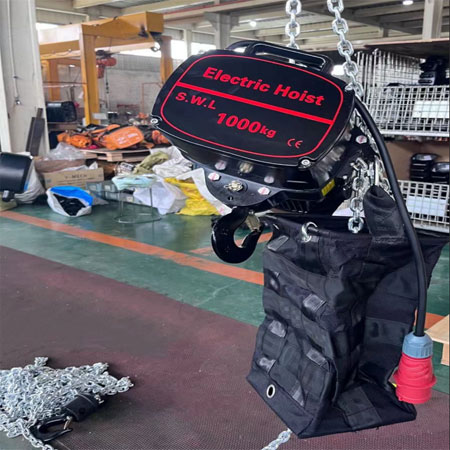
III. High Efficiency and Labor Saving, Adapting to High-Frequency and Multi-Scenario Operations on Stages
1. High Lifting Efficiency
The rated lifting speed of stage hoists with lifting capacity 0.25 - 3 tons is up to 3-12m/min. Compared with manual hoists (with a lifting speed of only 0.5-1m/min), the efficiency is increased by 5-10 times. It is suitable for rapid setup/dismantling of large stages and exhibitions (e.g., completing the hoisting of multiple stage sceneries and lighting equipment in one day).
2. Labor Saving and Cost Reduction
No manual dragging is required—only one person is needed to operate the remote control of stage hoists to complete the lifting operation, replacing the traditional manual hoist mode that requires 2-3 people to cooperate. This reduces labor input and avoids fatigue errors caused by manual operation (e.g., unstable speed due to long-term manual lifting).
3. Strong Continuous Operation Capability
The motor of the stage hoist uses high-quality copper wire windings, featuring good heat dissipation performance and long-term continuous operation (the duty cycle of some models is ≥40%). It adapts to the "continuous operation and tight schedule" needs of stage setup, without frequent shutdowns due to motor overheating.
IV. Compact Structure, Adapting to Complex Installation Environments of Stages
1. Small Size and Light Weight
The stage hoist has a compact design (e.g., the stage hoist part has a low height and narrow width) and light weight (the self-weight of 1-ton models is usually only 50-80kg). It is easy to install in narrow spaces such as stage trusses, grid tops, and side stage brackets, without occupying too much stage space, and also convenient for transportation and handling (e.g., equipment transfer during cross-venue performances).
2. Adapting to Multiple Installation Methods
The stage hoist supports suspension installation, fixed installation, mobile trolley installation, etc., which can be flexibly adjusted according to the stage layout (e.g., fixed hoisting of lighting on the grid top, mobile hoisting of stage scenery on the side stage). It has strong compatibility and does not require additional modification of the stage structure.
3. Corrosion Resistance and Wear Resistance
The stage hoist adopts spray coating treatment, and key components (gears, hooks) are made of high-strength alloy steel, featuring corrosion resistance and wear resistance. It can adapt to the characteristics of "frequent use and variable environments" in stage performances (e.g., humid environments for outdoor performances, frequent start-stop for indoor performances) and has a long service life.
V. Adapting to Special Stage Needs with Strong Expandability
1. Synchronous Linkage Control
Multiple stage hoists can achieve synchronous operation through a controller (e.g., 4 stage hoists are required for synchronous lifting/traversal of large backdrops), ensuring stable loads and avoiding tilting and deformation. It adapts to the "synchronous operation of large equipment" needs on stages (e.g., integral hoisting of LED screens and large stage sceneries).
2. Low-Voltage Adaptation
Some models of stage hoists support safe low-voltage (e.g., 24V/36V) control circuits, avoiding electric shock risks in humid stage environments or crowded scenarios, and further improving use safety.
3. Convenient Maintenance
The key components of stage hoists (motor, gearbox, braking system) are designed in a modular manner, facilitating disassembly and maintenance. Daily inspections and minor fault repairs can be completed during stage performance intervals without affecting the performance progress.
Henan Dejun Industry Co., Ltd has been deeply engaged in the design and production of stage hoists for over 35 years. We can customize and provide the suitable lifting solutions for your stage. If you have any inquiries, you can feel free to contact us.
- The last one:Industrial Bridge Crane Introduction
- The next one:Introduction to Electric Winches
